Best intelligent automation for businesses in 2026: Ultimate guide
Discover the best intelligent automation for businesses in 2026. Compare top AI agents, RPA tools, and no-code platforms to automate your workflow.
Most growing businesses reached a point where manual work became a tax on their growth. You bring on new clients and spend the next day buried in admin. You deliver excellent results but never find time to collect the testimonial. Every repetitive task is a drain on your finite energy. By 2026, the gap between organizations that have mastered automation and those still relying on manual entry has widened. The focus shifted from simple bots doing tasks to goal-oriented AI agents that handle messy, real-world variability.
If you're looking for a way to give your team hours back in their week, you're in the right place. We'll explore the best intelligent automation platforms for 2026, from enterprise leaders to no-code tools that any business can use to move toward autonomy.
What is intelligent automation?
Intelligent automation (IA) is the evolution of traditional automation. It combines robotic process automation (RPA), artificial intelligence (AI), and machine learning into a unified capability. While traditional RPA follows rigid, rule-based scripts, intelligent automation is context-aware. It can interpret unstructured data like emails, PDFs, and voice recordings to make sensible calls without landing on a human's desk.
Think of it as the difference between a machine that only follows a recipe and a chef who can adjust the seasoning based on the ingredients. The key components that make this possible include:
- AI agents: These are autonomous entities that can pursue multi-step goals, browse the web for information, and coordinate with other agents to complete complex tasks.
- Natural language processing (NLP): This allows the system to read, understand, and even draft replies to customer inquiries or supplier emails.
- Computer vision: This capability enables AI to "see" and extract data from documents like supplier invoices or identity documents with high precision.
The goal of these systems is to move businesses from automation to autonomy, where the tools work quietly in the background so your team stops noticing them.
Why intelligent automation matters in 2026
In 2026, AI agents have become mission-critical infrastructure for growing businesses. They aren't just experimental pilots anymore. They are the engine that handles the repetitive work that previously slowed teams down.
The efficiency gains are tangible. Research shows that intelligent automation can reduce manual data entry by 10% and save an average office worker over 1,000 copy-paste activities each week. For a growing business, this doesn't just mean fewer errors; it means reclaiming hours that can be poured into strategic work.
We call this the "quiet ROI." It's not about flashy dashboards, but about achieving better accuracy and reduced cycle times in your core operations. Whether it's processing credit agreements 95% faster or reducing loan funding times to two minutes, the impact is clear. This alignment with our vision of effortless action allows you to focus on the work that actually grows your business.
Our criteria for the best automation tools
To help you find the right fit, we evaluated the top platforms using a consistent set of criteria for 2026. Here is what we looked for:
- Agentic capability: We preferred tools that can handle multi-step goals rather than just simple tasks. Can the tool browse, decide, and act on its own?
- Ease of use: While some platforms are developer-focused, we looked for no-code or low-code interfaces that allow business users to build and modify workflows.
- Integration breadth: A tool is only as good as its connections. We assessed how well each platform integrates with core systems like Xero, HubSpot, and Salesforce.
- Security and governance: Data privacy is paramount. We looked for compliance with global standards like GDPR and local regulations like the Australian Privacy Act.
Comparison of the best intelligent automation platforms in 2026
| Platform | Target audience | Core strength | Pricing model |
|---|---|---|---|
| Mushin | Growing AU businesses | End-to-end implementation & edge cases | Custom ROI-focused |
| SS&C Blue Prism | Large enterprises | Security & strict governance | Subscription |
| UiPath | Enterprise-scale teams | Agent Builder & support ecosystem | Tiered subscription |
| Automation Anywhere | Distributed organizations | Cloud-native APA & AI Agent Studio | Subscription |
| n8n | Technical teams | Flexibility & self-hosting options | Usage-based |
| Make | SMBs & creative teams | Visual logic & branching | Credit-based |
| MS Power Automate | Microsoft ecosystem users | Deep M365 & Teams integration | Per-user/flow |
The 7 best intelligent automation tools for 2026
1. Mushin
We built Mushin specifically for growing Australian businesses that want the power of intelligent automation without the enterprise price tag or complexity. We don't just give you a tool; we are an implementation partner that tunes AI to how your business actually runs.
We focus on Accounts & Admin automation to handle supplier invoices, Customer Enquiries to triage your inbox, and Reporting & Ops to ensure your Monday morning reports are ready before you sit down.
- Key differentiator: We provide "Data stays yours" local security that complies with the Australian Privacy Act, ensuring your sensitive business data never leaves the country.
- Human-in-the-loop: Sensitive actions wait for your sign-off, so you stay in control while the AI handles the heavy lifting.
- Pricing: We offer custom solutions focused on tangible ROI, turning hours of manual effort into minutes of review.
2. SS&C Blue Prism
SS&C Blue Prism is an enterprise leader in intelligent automation, known for its robust governance and security. It is the go-to choice for businesses in highly regulated industries like banking and healthcare that need a full audit trail for every action.
The platform centers around WorkHQ, a unified control hub that brings humans, AI agents, and digital workers together. Their AI Gateway provides a framework to accelerate AI integration with built-in guardrails and risk notifications.
| Plan | Price | Key features |
|---|---|---|
| Enterprise | Custom | Includes WorkHQ, Chorus orchestration, and AI Gateway access |
- Pros: Strong compliance controls and auditability, making it ideal for regulated environments.
- Cons: It has a steeper learning curve and the licensing can be expensive for smaller teams.
Introducing automation and AI into our complaints workflow has given us the confidence that every case is handled consistently and in line with FCA expectations. We've reduced manual effort, improved accuracy and given our team more capacity to focus on complex, value-added tasks.
3. UiPath
UiPath remains a powerhouse in the automation space by blending robotic precision with AI agents. Their Agent Builder allows teams to design custom agents tailored to specific business needs, such as extracting data from complex documents or automating testing.
We like their Autopilot feature, which is a generative AI assistant that lets you build and run automations using natural language. This significantly lowers the barrier for entry for teams that don't have deep technical expertise.
| Plan | Price | Key limits |
|---|---|---|
| Basic | $25/month | Personal automations, 2 robots |
| Standard | Contact Sales | Full agentic automation, no scale limits |
| Enterprise | Contact Sales | Self-healing UI, premium governance |
- Pros: Intuitive visual workflow builder and an extensive community support ecosystem.
- Cons: The licensing can be complex and it might be overkill for very small, simple workflows.
4. Automation Anywhere
Automation Anywhere is built for scale, offering a cloud-native platform that focuses on Agentic Process Automation (APA). Their AI Agent Studio is a standout feature, allowing you to build and deploy agents across different large language models.
They've reported an impressive 84% auto-resolution rate for IT service desk use cases, proving that their agents can handle real customer problems autonomously.
- Pros: Large library of pre-built bots and strong generative AI integration for diverse repetitive tasks.
- Cons: Some AI features are still maturing and the pricing can be steep for SMBs compared to no-code alternatives.
Automation Anywhere had good standards and excellent support, in terms of architecture, design, and user interface, we chose Automation Anywhere, It also has good community support.
5. n8n
n8n is a "fair-code" tool that is popular among technical teams and developers. It's highly extendable, allowing you to run custom JavaScript or Python directly within your workflows. This is the core engine we use at Mushin because it allows for the level of customization that growing businesses need.
Their AI nodes make it easy to connect to LLMs and vector stores to build your own agents from scratch.
| Plan | Price (Annual) | Executions |
|---|---|---|
| Starter | $20/month | 2.5K |
| Pro | $50/month | Custom |
| Business | $800/month | 40K |
- Pros: Massive integration library and the option to self-host for maximum data control.
- Cons: It requires more technical setup than "plug-and-play" tools like Zapier.
6. Make
Make (formerly Integromat) is perhaps the most visual no-code platform available. It uses a "bubbles" interface that lets you see exactly how data flows through your scenarios. It's excellent for businesses that need complex logic branching without writing code.
They've recently introduced AI Agents (Beta) that allow you to build agents using their built-in provider or your own API keys.
- Pros: Highly intuitive interface and thousands of connectors for rapid SaaS integration.
- Cons: Pricing scales quickly if you have workflows with high task usage.
7. Microsoft Power Automate
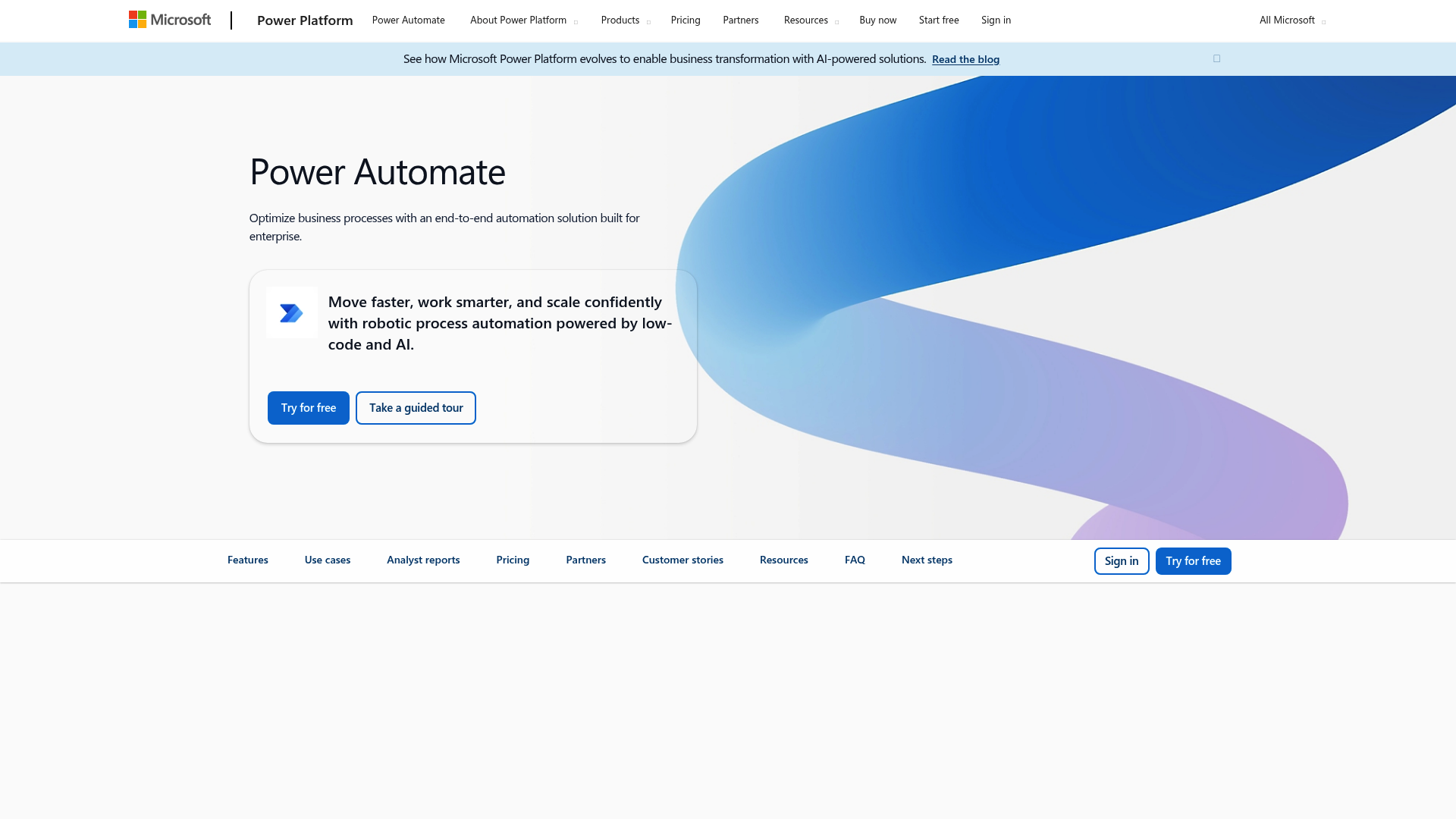
For businesses already deep in the Microsoft 365 ecosystem, Microsoft Power Automate is the default choice. It's seamlessly integrated with Teams, Excel, and Outlook, making it easy to automate internal approvals and notifications.
Their Copilot builder uses natural language to help you describe the workflow you want, and the AI generates the initial structure for you.
| Plan | Price (Annual) | Key inclusions |
|---|---|---|
| Premium | $15/user/mo | Cloud flows, Attended RPA |
| Process | $150/bot/mo | Unattended automation |
- Pros: Lower cost of entry for M365 users and native integration with the full Microsoft stack.
- Cons: Limited capabilities for non-Microsoft tools and advanced workflows can become difficult to manage.
Choosing the right intelligent automation for your business
Picking a tool is only the beginning. To get the best results from intelligent automation in 2026, we recommend a platform-first philosophy rather than just collecting point solutions.
Start with a process assessment. Look for high-volume, rule-based bottlenecks that slow your team down or cause errors. But remember: if a process is broken, automation will just help it fail faster. Fix the workflow first, then automate.
Match the tool to your team's skills. If you have developers on staff, n8n offers the most flexibility. If you're a business-led team, Make or Microsoft Power Automate are more accessible. Most importantly, consider your data security requirements. Ensure your chosen platform complies with the Australian Privacy Act if you're handling local customer data. We've seen many businesses succeed by starting small, automating one key workflow like invoice processing, and scaling from there.
Start your automation journey with Mushin
At Mushin, we believe the best tools are the ones your team stops noticing because the work just gets done. We combine the flexibility of tools like n8n with expert AI implementation to take the heavy lifting off your plate.
Whether you're looking to automate your accounts, triage customer enquiries, or streamline your operations, we provide the local support and technical expertise to ensure you see a tangible ROI.
Ready to move from automation to autonomy? Book a friendly 30-minute discovery call with us. No tech background is required, just a desire to get hours back in your week and focus on the work that actually grows your business.
Frequently Asked Questions
What are the primary benefits of the best intelligent automation for businesses in 2026?
The primary benefits include significant time savings (reclaiming hours in your week), reduced operational costs, and higher accuracy in data processing. By 2026, businesses also use it to handle complex decision-making through AI agents, moving beyond simple task automation.
How do AI agents fit into the best intelligent automation for businesses in 2026?
AI agents are the 'brain' of modern automation. Unlike old bots that follow set rules, agents can pursue goals, adapt to changing information, and coordinate across multiple systems like your CRM and email to complete entire business processes autonomously.
Is data security a concern when using the best intelligent automation for businesses in 2026?
Yes, data security is critical. When choosing a platform, ensure it complies with global standards like GDPR and local laws like the Australian Privacy Act. At Mushin, we emphasize that 'Data stays yours' to ensure your sensitive business information remains secure.
Can small businesses afford the best intelligent automation for businesses in 2026?
Absolutely. While enterprise tools like Blue Prism exist, platforms like Make, n8n, and Mushin provide scalable options that are affordable for growing businesses. You can start with one high-impact workflow and scale as your ROI grows.
What is the first step to implementing the best intelligent automation for businesses in 2026?
The first step is a process assessment. Identify the manual, repetitive tasks that drain your team's energy. Once you've identified these bottlenecks, you can fix the workflow and then choose the right tool to automate it.
Does the best intelligent automation for businesses in 2026 require a technical background?
Not necessarily. Many of the top tools are 'no-code' or 'low-code,' meaning you can build workflows with visual interfaces. However, for complex implementations, partnering with an expert like Mushin can ensure the AI is tuned correctly to your specific business needs.
What is 'Quiet ROI' in the context of the best intelligent automation for businesses in 2026?
Quiet ROI refers to the steady, reliable gains you get from automation like fewer mistakes, consistent reporting, and hours returned to your team rather than flashy but less impactful features. It’s the kind of ROI that allows you to focus on growth without being bogged down by admin.
Ready when you are
See what intelligent automation could do for your business
A friendly 30-minute conversation. No tech background required, no hard sell — just a look at the manual work slowing you down.
Book a Discovery Call